
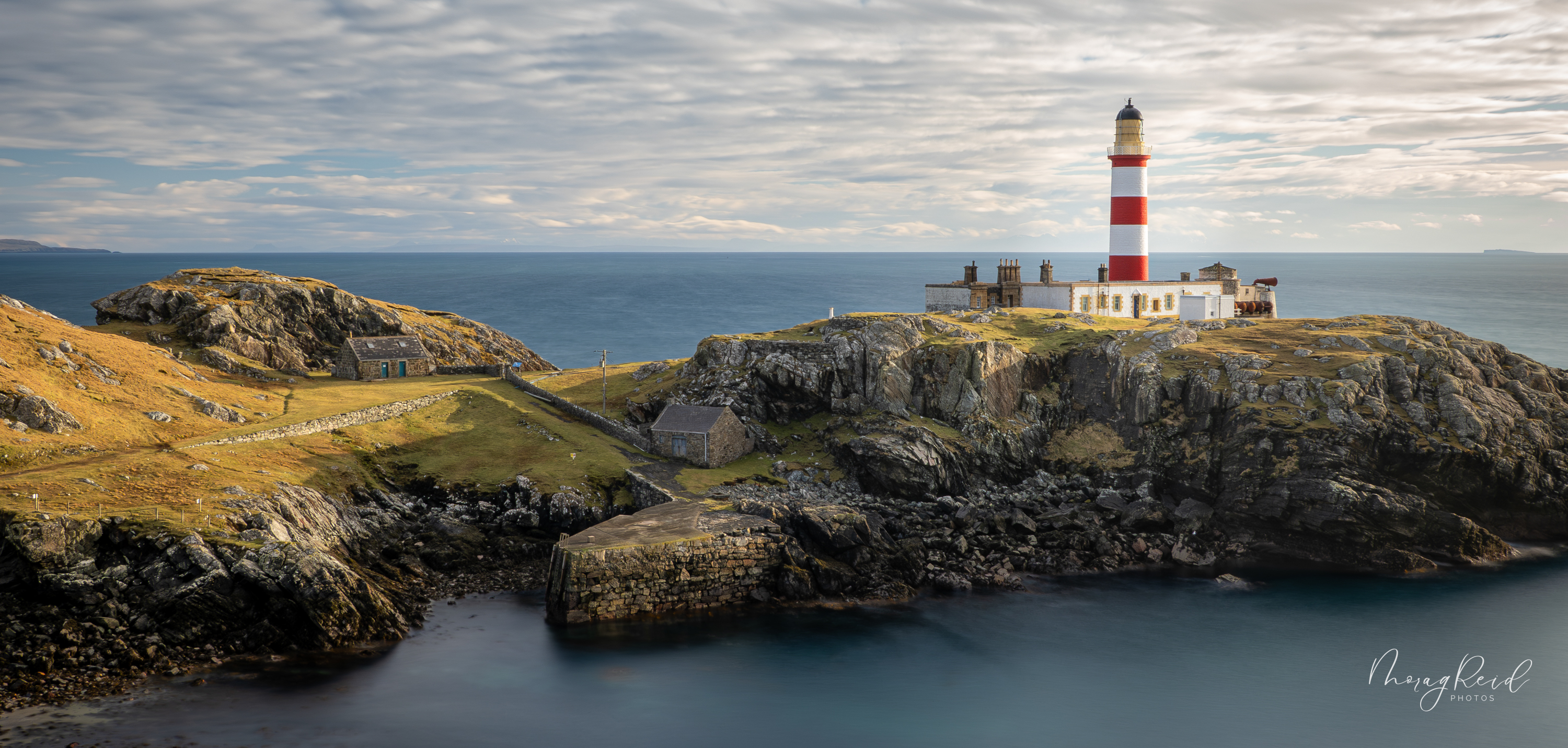
Eilean Glas Lighthouse
Eilean Glas Lighthouse stands on the eastern coast of Scalpay, overlooking the Minch between the Outer Hebrides and the Scottish mainland. Its position made it an important guide for vessels navigating the busy but hazardous waters around Harris, Lewis and Skye.
The first lighthouse was established in 1789, making Eilean Glas one of the first four lighthouses commissioned by the newly formed Commissioners of Northern Lighthouses, now the Northern Lighthouse Board. It was designed by Thomas Smith, an Edinburgh engineer who helped pioneer Scotland’s early lighthouse system.
The first keeper was Alexander Reid, who reportedly served at Eilean Glas for approximately 35 years and lived at the remote station with his family. Life for the early keepers would have been isolated and demanding, particularly during the fierce winter storms that sweep across the Minch.
The Stevenson lighthouse
The original tower was replaced in 1824 by the present lighthouse, designed by Robert Stevenson, Thomas Smith’s stepson. Stevenson was part of the celebrated family of engineers responsible for many of Scotland’s most famous lighthouses.
The new circular masonry tower rose to approximately 30 metres, giving the light greater height and visibility. Over the following decades, its lighting equipment was repeatedly improved. In 1852, the fixed light was replaced with a more effective revolving lens system.
Its distinctive red-and-white bands were added as a daytime identification mark, allowing sailors to recognize the lighthouse even when the lamp was not visible. The tower’s two broad red bands remain one of its most recognizable features.
Keepers and automation
For almost two centuries, lighthouse keepers and their families maintained the lamp, machinery and surrounding buildings. Supplies had to be brought to the remote station, while the keepers endured long periods of isolation and unpredictable Hebridean weather.
Eilean Glas became one of the Northern Lighthouse Board’s earlier automated stations in 1978, ending the need for resident keepers. Its fog signal was later discontinued, although the old horn remains at the site as a reminder of the lighthouse’s working past.
The lighthouse remains operational today under the Northern Lighthouse Board. Standing above the rocky shoreline, it continues the duty it began more than two centuries ago—guiding ships safely through the Minch and marking the eastern edge of Scalpay.

